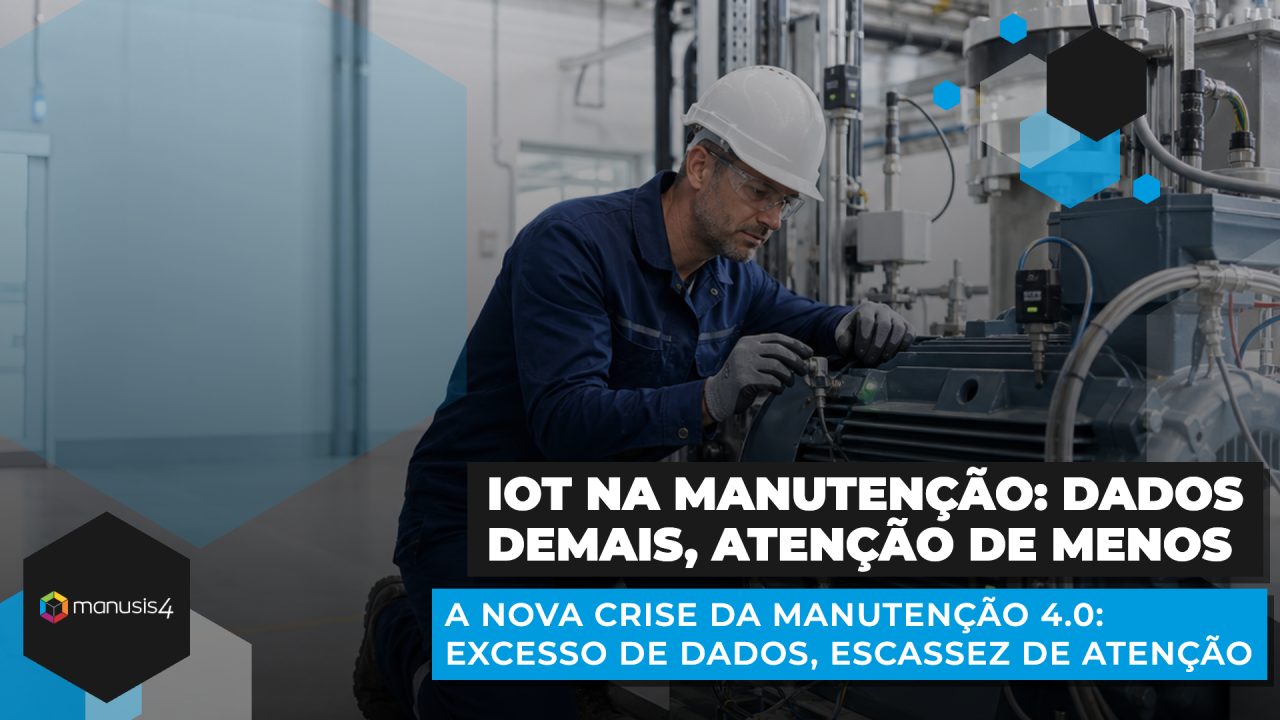
You have more sensors than ever. And you make fewer clear decisions than you did 10 years ago.
It's been about a decade since the promise of IoT hit industrial maintenance in full force.
It was a beautiful promise:
- Sensors on every critical asset
- Real-time data flowing all day long
- Early warnings preventing failures
- Decisions based on evidence, not intuition
- A smart, automated, precise operation
And, in many ways, that promise came true.
Today you probably have far more sensors installed than you dreamed of 10 years ago.
Far more data coming in every minute.
Far more dashboards available.
Far more KPIs to track.
And at the same time, if you're honest with yourself:
👉 Are your decisions clearer today than they were before all this arrived?
Or have you become hostage to a silent flood nobody saw coming?
Alerts nobody investigates.
Notifications nobody opens.
Reports nobody finishes reading.
Dashboards nobody digs into.
Anomalies piling up with no response.
And that nagging feeling that, despite all the investment in technology, something essential is being lost in the noise.
If this sounds like you, know that you're not alone.
This is the new silent crisis of Maintenance 4.0.
And it has a name:
👉 Paralysis from too much data.
The old pain IoT promised to solve — and the new problem it created
Before the IoT era, maintenance's problem was clear:
👉 Not enough data.
Decisions were made based on intuition, veteran experience, monthly spreadsheets, late reports. A lot of important things happened between reports — and nobody knew.
IoT solved that brilliantly.
Today the problem is the opposite:
👉 Too much data. Not enough attention.
And it's a new problem nobody was trained to handle.
- Maintenance engineers were trained to do technical analysis — not to filter massive volumes of signal.
- Supervisors were trained to lead teams — not to decide what to ignore among 400 alerts a day.
- Managers were trained to defend budgets — not to defend the focus of their own minds.
And the result is a team that's technically equipped — and cognitively overloaded.
Too many sensors.
Too many alerts.
Too many dashboards.
Too many meetings about dashboards.
And in the middle of it all, what matters gets diluted.
What NLP teaches about attention in stimulus-rich systems
Neuro-Linguistic Programming is clear on a principle rarely discussed in the engineering world:
The human mind processes about 40 bits of conscious information per second — amid millions of unconscious bits that go unnoticed.
In other words: our capacity to focus is biologically limited — much more than we'd like to admit.
And when an environment pushes more stimuli than the brain can process, three things happen:
- The mind shuts off automatically to protect itself. That's why you stop seeing alerts — you literally stop noticing them.
- Intuition becomes noise — and in maintenance, intuition is gold. Decades of experience get buried under irrelevant dashboards.
- Decisions become reflexes, not choices. You stop choosing and start dismissing notifications on autopilot, just to breathe.
And then a hard truth shows up:
👉 Having more data doesn't make you decide better. It makes you decide faster — and often worse.
Technology alone doesn't fix this.
What fixes it is a new discipline:
The discipline of strategic attention.
5 symptoms of an operation intoxicated by too much data
If your team shows 3 or more of these signs, you're already in intoxication territory:
- Critical alerts get ignored along with trivial ones. The human eye can no longer tell them apart.
- Nobody can explain why a dashboard exists. It was created at some point and stays out of inertia.
- Data review meetings are draining and unproductive. Lots of information, few decisions.
- Veteran technicians' intuition was dismissed by data that "proved" otherwise. And later it turned out the intuition was right.
- New sensors are proposed as the solution to decision problems. When the real problem is attention — not measurement.
If you recognized your operation in at least three of these symptoms, know this:
👉 Your next strategic turn isn't technical. It's cognitive.
Where does Manusis4 fit in the discipline of strategic attention?
We've been working on this philosophy inside the platform for a few years.
We don't believe a good IoT solution should deliver more data.
It should deliver more clarity.
And clarity is something completely different.
What Manusis4 has been doing to reduce paralysis from too much data:
- Alerts ranked by real criticality — not by the sensor's default volume
- Manusis4's AI does a first triage and highlights only what needs a human decision
- Adaptive dashboards — that show less, so you can see more
- Smart silences — the system learns when NOT to notify you
- Automatic correlation between events — to bring the number of "apparent problems" down to the real number of "true problems"
- Executive mode — that condenses 400 metrics into 5 KPIs that actually move the business
In other words: Manusis4 isn't just a mass data collection platform.
It's a platform for strategic curation.
And that's a difference only someone who has suffered from data overload can fully appreciate.
Because, as every experienced professional finds out at some point:
👉 The best thing about IoT isn't what it shows you. It's what it lets you stop looking at — because everything is under control.
How to recover strategic attention in an overloaded operation
If you want to start reversing data paralysis today, try these 4 moves:
- Take inventory of the alerts from the last 30 days.
How many required real action? If the rate was below 20%, you have too much noise.
- Eliminate 30% of your active dashboards.
Don't be afraid. If nobody misses them in 60 days, they shouldn't exist.
- Downgrade at least half of your alerts to "on-demand lookup."
Not everything needs to scream in real time. Many things fit in a weekly review.
- Restore the team's right to say "I didn't see value in that data."
That's a sign of maturity — not inattention.
Four moves.
No additional cost.
All with the potential to give clarity back to a suffocated operation.
And the change the team feels in the first week is almost physical:
👉 Less noise. More discernment. More conscious decisions.
This week's reprogramming
"My scarcest asset today isn't sensors. It's attention. And my team's attention is my responsibility — taking care of it is as strategic as taking care of the physical asset."
Repeat this sentence before the next proposal to "install more sensors."
Before creating the next dashboard.
Before the next meeting with 40 slides of KPIs.
And notice how your management becomes, at the same time, more technological and more human.
To wrap up
The IoT era gave us an abundance of data previous generations could only dream of.
But it also handed us — quietly — a new responsibility:
👉 The responsibility to protect human attention in the middle of the digital flood.
Companies that learn this discipline first:
- Will make faster, more accurate decisions
- Will have less exhausted, more engaged teams
- Will extract far more value from the same technology infrastructure
- Will attract people who run from cognitively chaotic environments
- Will lead digital transformation with amplified human intelligence — not replaced
Because, deep down:
Sensors measure the asset. Attention leads the asset.
And the greatest technology in Maintenance 4.0 is still the human mind that knows where to look.
Next week, we continue the Block 9 journey talking about the silent emotional challenge of adopting AI on the shop floor — and how to lead that change without alienating the people who really keep the operation running.
Until then.