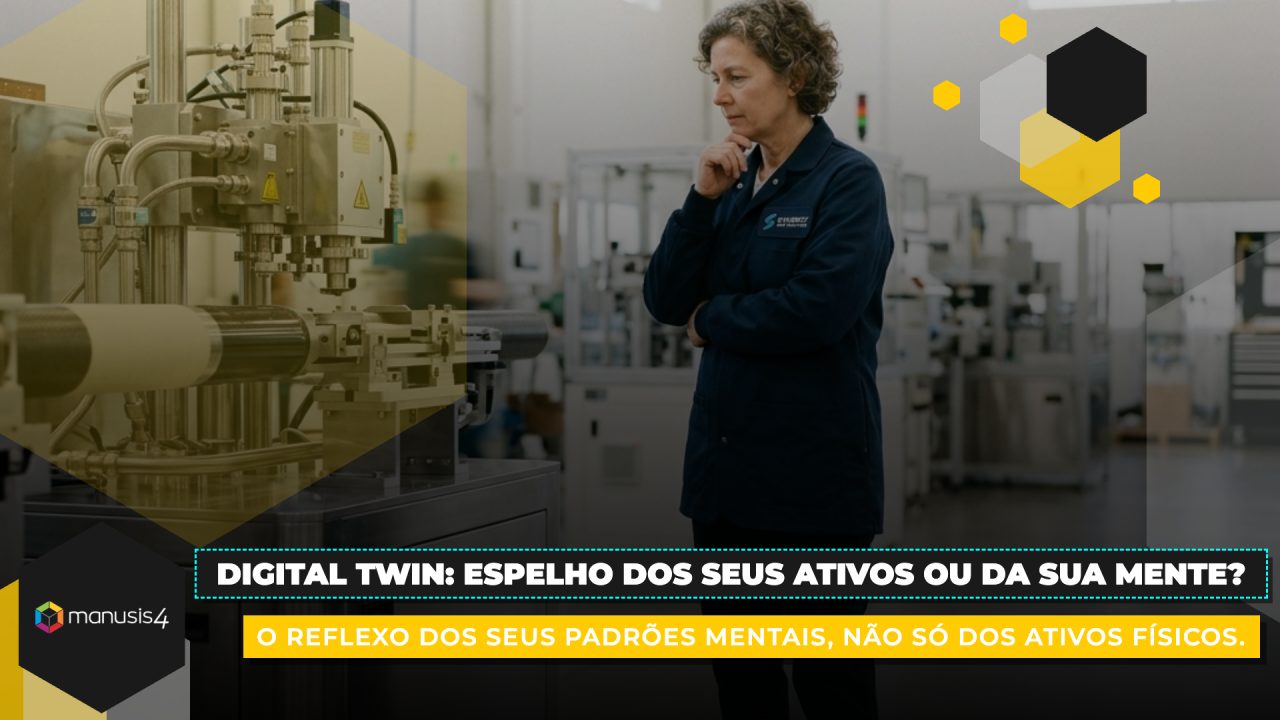
You think you're building a digital mirror of your assets. You're building a mirror of the way you think.
Welcome to Block 9 of our journey.
In recent weeks, we closed Block 8 with an important insight: asset management is people management in disguise.
Now we're opening a new front — and it comes with a bold invitation:
👉 Talk about digital transformation, yes. But with soul.
And the first step in this conversation is to look at one of the most celebrated — and most misunderstood — technologies of our time:
The Digital Twin.
Everybody talks about it.
Every consultant promises it.
Every platform announces it.
Every CEO hears about it at conferences.
And few really understand what it's doing to the mind of the person using it.
Because, yes: a Digital Twin is a powerful technology for simulating assets.
But it's also — and maybe mainly — a mirror of how the manager thinks.
And that's what we need to talk about.
What a Digital Twin is (and what it is NOT)
First things first, a clean explanation:
A Digital Twin is a living digital replica of a physical asset — fed by real-time data, able to simulate behavior, predict failures, and test scenarios without affecting the real operation.
It's an extraordinary technology.
But it is NOT:
- A static 3D copy of a piece of equipment
- A pretty monitoring dashboard
- A generic manufacturing simulation
- A promise of "everything automated, no people needed"
- A silver bullet that solves management problems
And this is where one of the biggest misunderstandings in the market lives.
Many managers start Digital Twin projects thinking they're buying automated operational intelligence.
And what they actually buy — when the project is done well — is a structured externalization of their own way of thinking about the asset.
A Digital Twin doesn't think for you.
It thinks WITH you.
And along the way, it exposes how you think.
What NLP teaches about externalized mental models
Neuro-Linguistic Programming is fascinating on a point that's rarely explored:
Every external model we create — a map, a plan, a system, a methodology — is a projection of our internal mental model.
And the Digital Twin is the most radical example of this in modern engineering:
- Which variables the manager chose to monitor → shows what he believes matters
- Which alerts he set up → shows the fears he carries
- Which scenarios he simulates → shows the hypotheses of his unconscious
- Which metrics he prioritizes → shows his personal definition of success
- Which data he ignores → shows the blind spots in his thinking
In other words: two managers can build Digital Twins of the same asset — and produce completely different systems.
Not out of incompetence.
Out of mental signature.
And that's where it gets interesting:
👉 When you look at your asset's Digital Twin, you're looking at a version of yourself.
Your way of reasoning about risk.
Your way of setting priorities.
Your way of organizing variables.
Your way of projecting the future.
It's all there — translated into code, sensors, and dashboards.
And few managers realize it.
The silent risk of a Digital Twin built without awareness
When the manager doesn't understand that the Digital Twin is a mirror of his mind, he makes three silent mistakes:
- He automates his own biases.
If he always underestimated lubrication — so will the Digital Twin.
If he always put cost ahead of reliability — the Digital Twin will simulate decisions in that direction.
If he's afraid to say "I don't know" — the Digital Twin will produce falsely confident answers.
- He hands intelligence over to a machine that only reproduces what he already thinks.
Believing he's evolving, he's just amplifying his own limits — with computational precision.
- He misses the chance to know himself.
A well-built Digital Twin shows, with surgical clarity, where the gaps are in the manager's way of thinking.
Ignoring that mirror is wasting the greatest gift digital transformation can deliver: real-time executive self-knowledge.
These three mistakes happen quietly.
In giant companies.
With expensive platforms.
With well-known consulting firms.
And the result is a Digital Twin that works technically — but can't change the operation, because it only reproduces the mind that created it.
Where does Manusis4 fit in this expanded awareness?
Manusis4 has been building its Digital Twins with a different philosophy.
We don't sell "automating the mind" — we sell a conscious mirror of the operation.
What does that look like in practice?
- Manusis4's Digital Twins are built together with the team — not imposed by outside consultants
- With every configuration, the manager is invited to explain the "why" — which reveals his internal criteria
- The dashboards allow multiple views (not just the senior manager's) — which widens the system's cognitive range
- Alerts can be questioned and recalibrated — which keeps old biases from hardening
- Manusis4's AI suggests angles the manager didn't ask for — expanding the operation's mental horizon
- IoT integration brings data that sometimes contradicts the manager's intuition — training the team to doubt itself with humility
In other words: Manusis4 doesn't try to replace the manager's mind with the system's.
It tries to enrich the manager's mind with the system's intelligence.
And that subtle distinction makes all the difference.
How to use your Digital Twin as a tool for executive self-knowledge
If you already use (or plan to use) a Digital Twin on any asset, try these four questions — periodically:
- "Which decision about this asset do I hand over entirely to the Digital Twin? And why?"
If the answer is "all of them," be careful: you're outsourcing judgment.
- "Which variable did I choose to monitor that no other manager in my company would?"
That reveals your cognitive edge.
- "What data does the Digital Twin show me that I feel like ignoring?"
The point where you resist is where your biggest lesson lives.
- "If another manager inherited this Digital Twin, what would he change in the next 48 hours?"
That helps you see your own biases from a critical distance.
Four questions.
Zero additional investment.
No new sensors.
Just the commitment to look at the digital mirror as a mirror — not as an oracle.
This week's reprogramming
"My Digital Twin doesn't think for my asset. It thinks WITH it — and with me. And the intelligence no system delivers on its own lives precisely in the conversation among the three of us."
Repeat this sentence before your next sensor configuration.
Before your next decision based only on the simulation.
Before the next automatic recommendation you almost accepted without questioning.
And watch your relationship with technology change — into a mature, critical, and productive one.
To wrap up the opening of Block 9
The great promise of digital transformation in maintenance isn't to replace human intelligence.
It's to expand it.
And that expansion only happens when the manager understands that:
- Every sensor installed is your choice
- Every alert configured is your fear
- Every dashboard prioritized is your value
- Every Digital Twin built is your portrait
And then, when you look at all that technology infrastructure, you realize something profound:
👉 Digital transformation isn't about machines getting smarter. It's about managers becoming more aware.
That's the essence of "digital transformation with soul."
And that's what we'll go deeper into over the coming weeks of Block 9, diving into IoT, AI applied to maintenance, adopting technology without losing the human side, and the manager's emotional role amid so much innovation.
It's going to be a rich journey.
Until then.