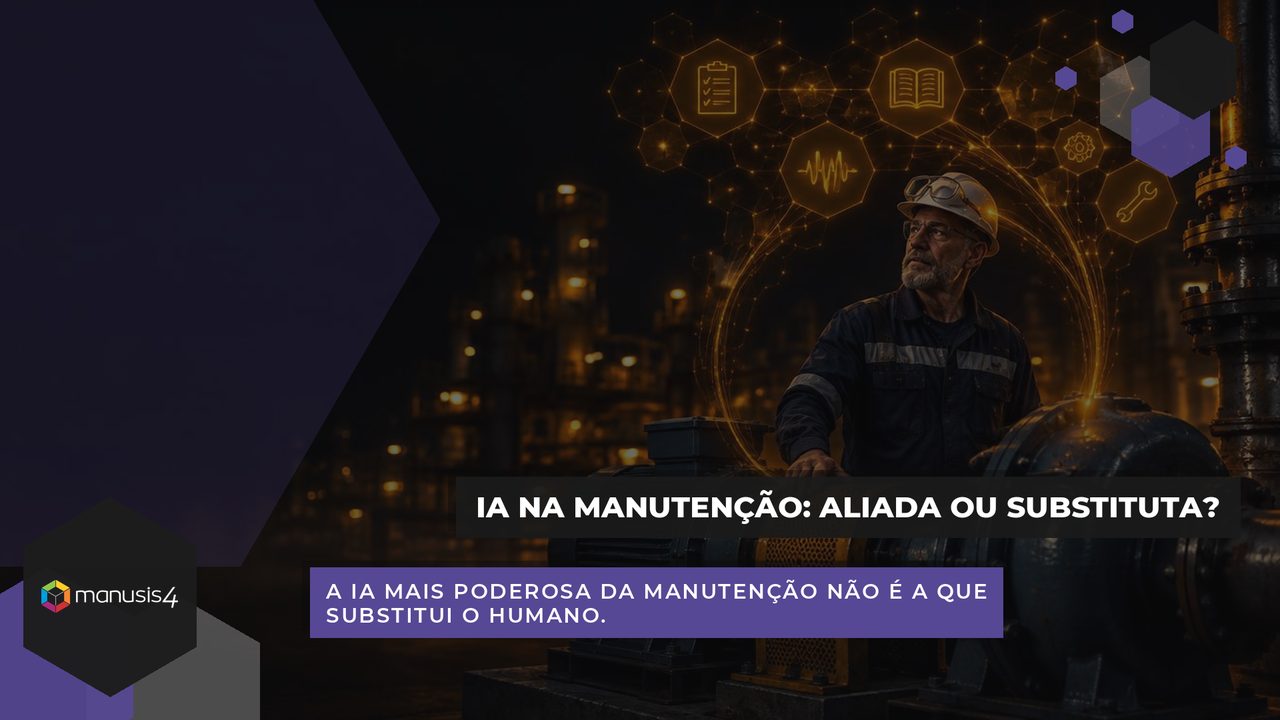
Nobody says it out loud. But everyone thinks it: "is this AI here to replace me?"
There's a scene that repeats itself in thousands of industrial operations in Brazil and around the world, and almost nobody names it honestly.
The manager proudly announces that the company is going to start using AI in maintenance.
He talks about predictive analytics.
He talks about smart patterns.
He talks about automatic optimization.
He talks about "raising the department's game."
And he looks at the team expecting enthusiasm.
What he gets back is a strange reaction:
- Polite but cold applause.
- Smiles that don't reach the eyes.
- Technical questions — just a few.
- Silence at coffee after the meeting.
The manager walks out of the conversation wondering:
👉 "Why didn't they get excited?"
And the answer is simple — it's just that nobody says it out loud:
👉 Because, deep down, each one of them is asking: "Is this AI here to help me? Or is it here to replace me?"
That question is the invisible elephant in every AI project in industrial operations.
And if you don't look at that elephant with maturity, it quietly sabotages everything that comes after — even if the technology is excellent.
Why the fear of AI in maintenance is real (and legitimate)
First of all, we need to recognize this:
The fear of AI in maintenance isn't ignorance. It's historical intuition.
The Industrial Revolution replaced craftsmen with machines.
Automation replaced workers with robots.
Robotics replaced assemblers with work cells.
ERP replaced clerks with systems.
Every technological wave left a question hanging in the minds of the people doing the work:
👉 "Next time, will it be me?"
And in the mind of an experienced maintenance technician, that question weighs in a particular way. Because he spent decades building tacit knowledge — the kind you only learn after years with grease on your hands — and now he sees machines promising to "think" in his place.
It's not wounded pride.
It's not resistance to change.
It's not a lack of vision.
It's a legitimate existential concern about his own place in the world of work.
And when the leader treats it with mockery — "don't be old-fashioned," "embrace the future," "AI is here to add value" — he burns the bridge he'd need to build to lead adoption.
Because people who are afraid don't listen to motivational speeches.
People who are afraid listen to tangible evidence.
What NLP teaches about resistance to new technological identities
Neuro-Linguistic Programming is clear on this:
No human being embraces a technology they perceive as a threat to their professional identity — no matter how objectively good it is.
The human brain protects identity above reason.
And professional identity is one of the most protected pillars of the unconscious.
In other words: if the veteran technician perceives AI as a replacement, he will:
- Find problems where there are none
- Doubt things the AI got right
- Trust his own intuition more than the data
- Teach the new hires only part of how the system works
- Keep knowledge "only in his head" — to make himself irreplaceable
None of this is malice.
All of it is unconscious emotional self-protection.
And the leader who wants real AI adoption needs to understand that he's not dealing with technical resistance.
He's dealing with the preservation of professional identity.
And identity can only be preserved in two ways:
- You defend the old — and block the new.
- You rebuild the old into a new version — and the new settles in naturally.
The leader's path is the second one.
4 signs your team is resisting AI emotionally (even without saying so)
If you recognize 2 or more of these signs, know this: your team is asking for care — not more technical training.
- The AI suggests and nobody reviews it. Nobody accepts, nobody challenges. Silence is the most polite form of sabotage.
- Small system errors become big stories. A single false positive gets used for weeks as "proof" that "this still doesn't really work."
- The veteran technicians stop asking questions. They can read the system. But they're not emotionally available to master it.
- Meetings about AI turn into the manager's monologues. Nobody proposes uses, nobody suggests improvements, nobody gives constructive criticism. It's a polite void.
These 4 signs are universal.
And each one of them is a silent request for the AI to prove it came to add — not to subtract.
How Manusis4 designed its AI to dissolve that fear
When we started building Manusis4's proprietary AI, we made an important editorial decision from the very beginning:
The AI isn't here to think instead of the team. It's here to think WITH the team.
And that showed up in several layers of the product:
- The AI suggests, but it doesn't decide on its own. The final decision is always human.
- The AI explains why it suggested what it suggested. No "black box." No technological mysticism.
- The AI learns from the technicians' intuition. When someone challenges a suggestion, the system absorbs the reason — and grows.
- The AI exposes its own mistakes. It doesn't hide failure. It learns in the open.
- The AI extends the veteran technician's reach. He can now take care of more assets, with more quality — without losing authority.
- The AI is never presented as a replacement. It's presented as an intelligent assistant that asks before it acts.
And over time, that philosophy makes something powerful happen:
👉 The fear dissolves — not because the leader said "there's nothing to be afraid of."
👉 The fear dissolves because the AI proves, through daily actions, that it came to add.
That's the only real path to AI adoption in mature industrial operations.
Anything else is just talk — and talk doesn't stand the test of time.
How to introduce AI without alienating your team
If you're starting (or reintroducing) AI in your operation, try these 5 moves:
- Start by naming the fear — out loud.
Say it in the meeting: "I know there's a silent question in the air: did this technology come to replace someone? Let's talk about it openly." Fear shrinks just by being named.
- Make clear which human knowledge remains irreplaceable.
Judgment in unusual situations. The asset's history and context. The team's culture. Relationships with suppliers. AI does none of that.
- Put the veteran technicians in the role of training the AI — not being trained by it.
That changes everything. The emotional hierarchy is preserved.
- Publicly celebrate every AI win that came FROM A CONVERSATION with a human.
"The AI suggested X, but [name] pointed out Y — and the system learned from him." Every story like that becomes a cultural seed.
- Never use AI as an argument for cutting headcount.
If you do it once, every AI project in your career will suffer passive sabotage for the next 10 years.
Five moves.
Zero cost.
Huge impact.
This week's reprogramming
"AI in my department didn't come to take anyone's place. It came to extend everyone's reach. And my role as a leader is to make sure that truth is proven — day to day, with concrete actions — to every person on my team."
Repeat this sentence before your next meeting about AI.
Before the next announcement of a new automated feature.
Before your next conversation with a veteran technician.
And watch your leadership in the digital era gain a dimension no competitor understands.
To wrap up
The great historical mistake of previous technological waves was replacing without explaining.
And the cumulative price of that is the distrust every technical team carries today — even without saying it.
The great opportunity of the AI era in maintenance is to do it differently:
👉 Add without replacing.
👉 Extend without alienating.
👉 Automate without erasing authorship.
Companies that do this first:
- Will have technical teams that are emotionally available for innovation
- Will retain the best people in a market that competes for them
- Will create a culture of continuous learning between humans and systems
- Will reap, in 5 years, results their competitors will try to copy for decades
Because, deep down:
The most powerful AI in maintenance isn't the one that replaces humans.
It's the one that makes humans feel more capable than they've ever been.
And that's the philosophy behind Manusis4's AI.
And that's the philosophy that will drive the greatest success stories of Maintenance 4.0.
Next week, we continue Block 9 exploring the other side of this coin: what changes in the head — and the heart — of the manager when he stops being "the one who knows everything" and becomes "the one who orchestrates the intelligences."
A delicate transition. And a fundamental one.
Until then.