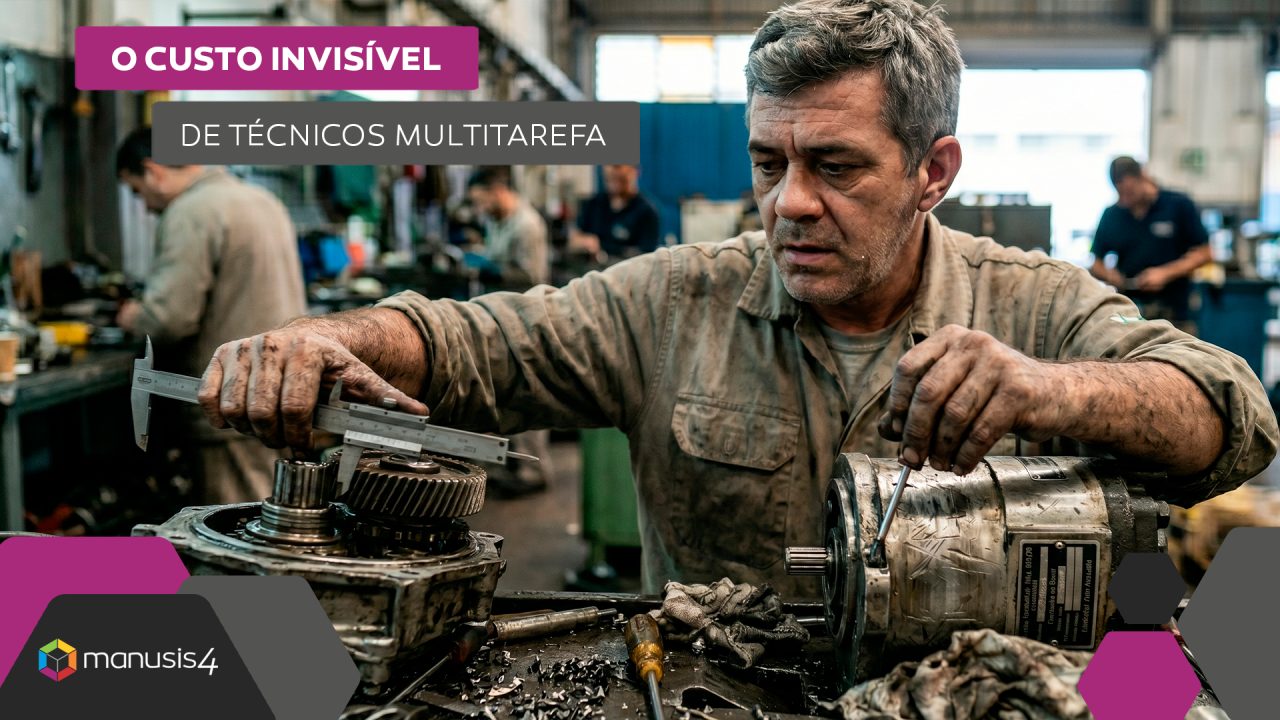
🧩 The most dangerous compliment in maintenance
"This guy does everything. Never stops. A real multitasker."
Have you heard that?
Have you said it?
Have you been proud to be seen that way?
In almost every company, the "multitasking technician" is treated as the ideal professional:
- Handles the critical work order
- Answers the manager's WhatsApp
- Trains the new hire
- Closes out the report
- Fixes HR's air conditioning on the way
- And still updates the system "real quick"
And the result looks impressive:
👉 He delivers everything.
👉 He shows up everywhere.
👉 He "saves the day" several times a week.
But what nobody sees is the silent cost of all that.
The technical truth few people tell
Multitasking doesn't exist.
At least not the way the market sells it.
What exists is rapid switching of focus, and that has a scientific name:
Switching cost.
Every time the brain jumps from one task to another:
- it loses performance
- it forgets details
- it makes half-baked decisions
- it builds up mental fatigue
- it generates invisible micro-errors
And at the end of the day, the "multitasking" technician delivers:
👉 more volume.
👉 less quality.
👉 more rework.
👉 more emotional wear.
The bill always comes. It just doesn't come right away.
What NLP shows us about this
Neuro-Linguistic Programming is clear:
The human brain was built for deep focus, not for constant fragmentation.
When you fragment your team's attention:
- they lose the sense of progress
- they lose clarity about priorities
- they lose the sense of a "finished task"
- they lose the satisfaction of a "job well done"
And they start living in a strange emotional state:
👉 Worked all day… but feels like nothing got done.
👉 Solved a lot of things… but ended up tired and irritated.
👉 Delivered a lot… but feels permanently behind.
That isn't a lack of ability.
It's fragmentation piling up over weeks and months.
The invisible costs of multitasking in maintenance
When a culture of fragmentation takes hold:
- Technical failures increase, from inattention
- Diagnoses get worse, from rushed analysis
- Accidents get closer, from distraction
- Conflicts grow, from broken communication
- Leaders burn out, from never finishing anything
- KPIs swing, for no apparent reason
And the most serious symptom:
👉 The team starts confusing busyness with productivity.
When that happens, the whole department goes into a mode of
"running all the time without getting anywhere."
Where does Manusis4 come in as an ally against fragmentation?
The great strength of Manusis4 lies precisely in giving focus back to the team.
How?
✔️ Prioritizing work orders by criticality, not by perceived urgency
✔️ Concentrating information in a single place, no more "I'll check email, WhatsApp and the spreadsheet"
✔️ Showing what each technician should do now, without noise
✔️ Eliminating rework caused by missing history
✔️ Letting decisions be made with data, not adrenaline
When the team reaches that level of organization:
👉 fragmentation goes down
👉 delivery improves
👉 emotions stabilize
Technology applied well simplifies the human brain,
and frees up room for what really matters.
The turning point
Multitasking isn't a virtue.
It's the symptom of an operation that has lost control of its priorities.
A true high performer isn't the one who does everything at once.
It's the one who knows how to choose what to do now, with clarity, presence and focus.
And a mature team isn't measured by how many tasks it juggles at once.
It's measured by the quality of what it delivers when it concentrates.
A simple practice to reprogram the team
Put the "focus blocks" ritual in place:
- 25-minute block: one task only, no WhatsApp, no interruptions
- 5-minute break: breathing, stretching, water
- Repeat 3 times during the shift: at the critical moments of the day
This cycle is known as the Pomodoro technique, but the essence goes deeper:
👉 It's an act of re-educating the mind.
👉 It's training against the anxiety of overstimulation.
👉 It's a reminder that focus is a muscle, and it needs to be exercised.
Start with a single technician.
Then with your leadership.
Then with the whole department.
Within a few weeks, the culture changes.
This week's reprogramming
"I don't need to do everything at once. I need to do what matters, at the right time, with my full attention."
Repeat that sentence before you open the first work order of the day.
Repeat it before every meeting.
Repeat it before every critical decision.
And notice how your output changes, with less effort.
To wrap up
Maintenance doesn't need multitasking heroes.
It needs whole professionals: full attention, on whole tasks.
Teams like that:
- make fewer mistakes
- deliver more
- suffer less
- grow more
And it all starts with a simple choice:
👉 Stop glorifying fragmentation. Start valuing focus.
Because in maintenance, just as in life,
those who focus, multiply.
Those who split themselves, wear out.