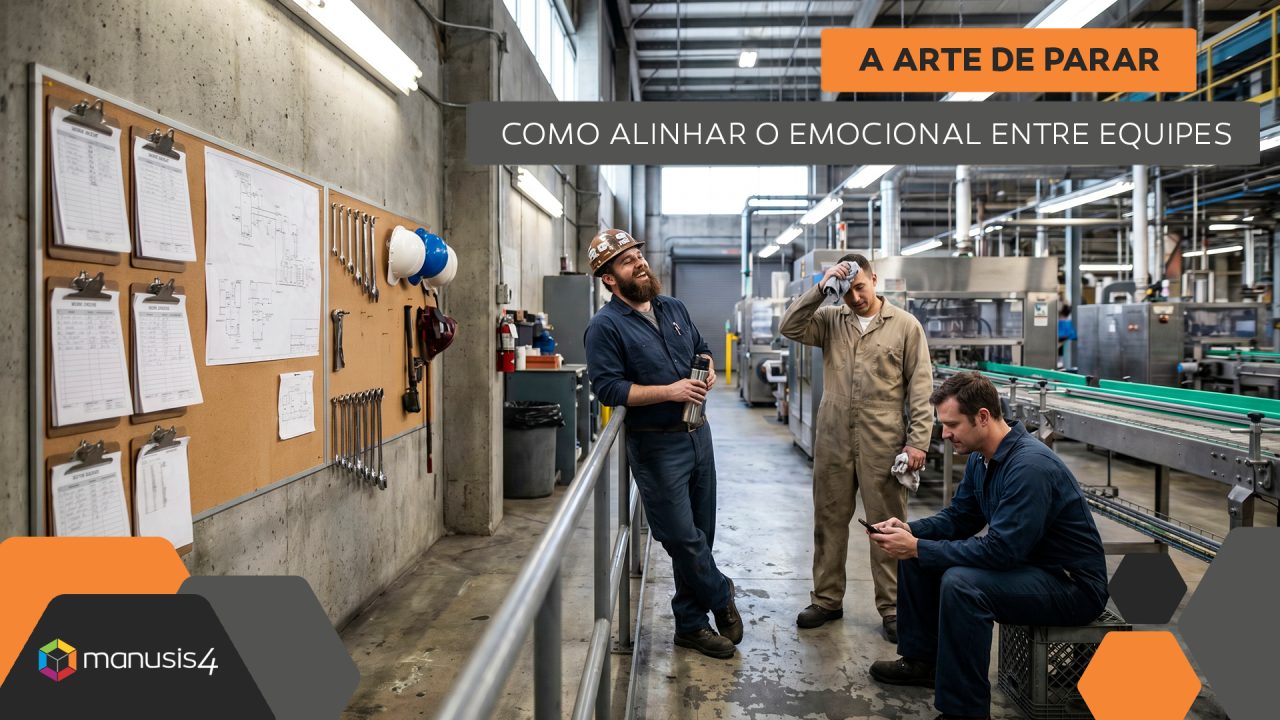
⏸ Those who stop… go further.
There's a silent phrase that haunts maintenance hallways:
"Stopping is a waste of time."
It isn't written anywhere.
Nobody pinned it to the bulletin board.
But it lives inside everyone who grew up on the shop floor.
And it sabotages the best of your team, every single day.
Because people who run on autopilot
believe speed means productivity.
It doesn't.
👉 Speed without pauses isn't performance.
It's a straight road to errors, rework and burnout.
The maintenance paradox nobody talks about
You take care of machines all day.
You know that if equipment runs nonstop,
without lubrication,
without adjustment,
without inspection…
👉 it fails.
👉 it wears out.
👉 it breaks.
But what about your mind?
And your team's minds?
We take better care of the steel asset
than of the human asset that runs the steel asset.
And then it's the technician who breaks.
The manager who freezes.
The whole department that falls apart.
What NLP shows us about pausing
Neuro-Linguistic Programming is blunt about this:
Tired mental states produce worse decisions. Always.
When the brain is in "overloaded" mode:
- perception narrows
- creativity drops
- frustration tolerance plummets
- communication gets more aggressive
- focus fragments
And the worst part:
👉 the person doesn't even realize they're in that state.
They keep deciding.
They keep leading.
They keep handling critical work orders.
But with a fraction of their real capacity.
The invisible costs of an operation that never pauses
Does a team that never pauses deliver results?
Yes, in the very short term.
But over the medium term:
- rework goes up
- interpersonal conflict goes up
- diagnostic errors go up
- absenteeism goes up
- turnover goes up
- the feeling that "nobody can take it anymore" goes up
And the most treacherous symptom:
👉 Productivity drops and nobody can point to why.
The KPIs look odd.
The atmosphere feels odd.
The meetings feel odd.
All because the human system ran without preventive maintenance.
Where does Manusis4 come in as an ally of the pause?
It may seem counterintuitive, but let me show you:
A pause is only possible when the operation has clarity.
And clarity comes from:
✔️ an organized maintenance schedule
✔️ visible, up-to-date priorities
✔️ tasks assigned with logic
✔️ a history that keeps work from being repeated
✔️ smart alerts that prevent "everything is urgent"
When the operation reaches that level of clarity with Manusis4:
👉 the manager trusts they can stop for 5 minutes
👉 the technician trusts they can breathe between one work order and the next
👉 the leader trusts the system is taking care of what's critical
Technology, applied well, gives the team back the right to pause.
The turning point
Pausing isn't the opposite of productivity.
Pausing is what sustains productivity through the day, the week, the month.
Athletes pause.
Surgeons pause.
Pilots pause.
Why would maintenance professionals, who make risk decisions all the time,
be the only ones without the right to pause?
A simple routine to reprogram the team
Put in place, together with your team, the "3 conscious breaths" ritual:
- At the start of the shift: before opening the first work order
- In the middle of the shift: after a demanding task
- At the end of the shift: before handing the environment over to the next crew
Each conscious breath takes 30 seconds:
- Breathe in deeply for a count of 4
- Hold for a count of 4
- Breathe out for a count of 6
- Repeat 3 times
Seems like too little?
That little is exactly what fits into the routine.
And it changes everything.
In 90 seconds total, the whole team gains focus, presence and clarity.
This week's reprogramming
"Pausing isn't stopping production. It's producing more intelligently."
Repeat that sentence before your next meeting.
Before your next critical work order.
Before your next tough decision.
And notice how your brain reacts differently.
To wrap up
The culture of rushing has become a point of pride in maintenance.
But the field's real maturity lies in understanding that:
👉 Those who pause, endure. Those who don't, collapse.
Pausing isn't weakness.
Pausing isn't a luxury.
Pausing isn't unproductive.
Pausing is strategy.
And it starts with something very simple:
Allowing yourself to breathe, and teaching your team to do the same.