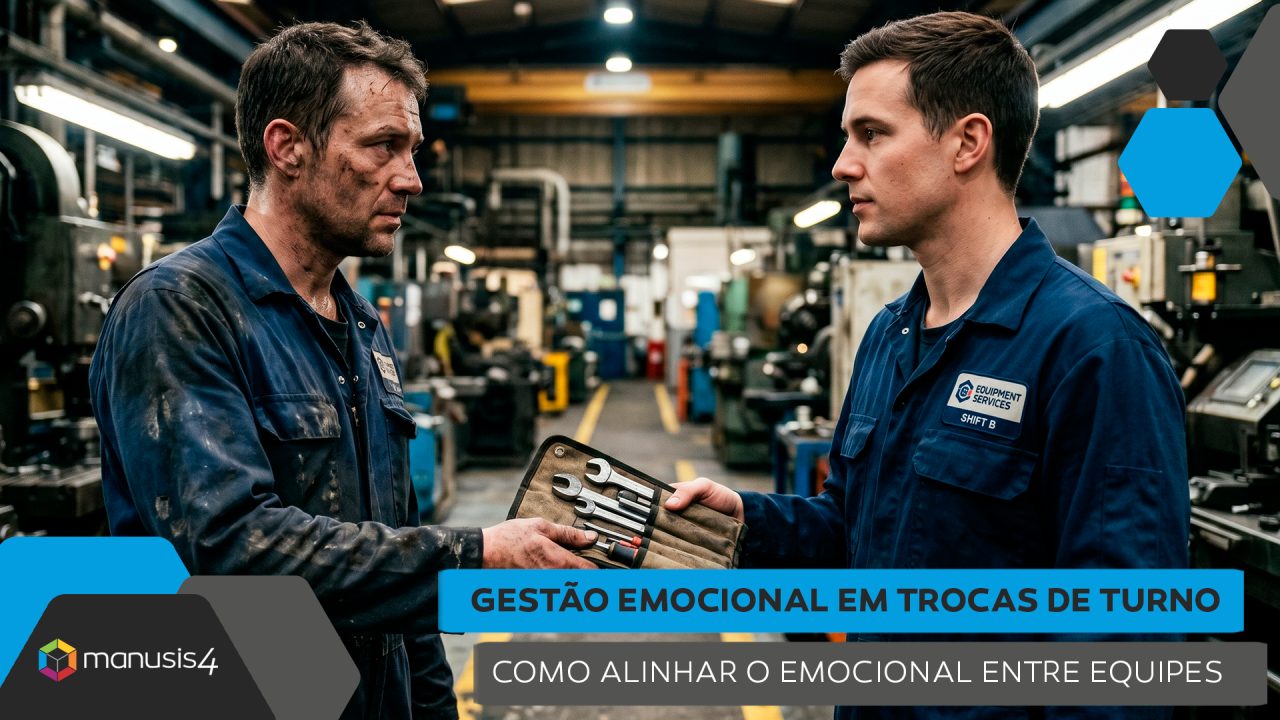
🔄 The shift ends… but the emotions keep circulating
Have you ever lived through this?
The morning crew leaves exhausted.
The afternoon crew arrives demanding answers.
The night crew complains about what was left behind.
And nobody talks about it openly.
Each shift hands over to the next:
- pending work orders
- critical equipment
- tools
- KPIs
But it also hands over, without realizing it:
- accumulated frustration
- judgment about the previous shift
- the rush of the people arriving
- the fatigue of the people leaving
👉 And that's where the invisible problem of most 24/7 operations lives.
🔧 The technical handover is easy. The emotional handover is the one nobody teaches.
In almost every maintenance operation that runs in shifts, the handover is:
✔️ quick
✔️ informal
✔️ improvised
✔️ focused on what broke
And there's almost never room to answer one simple question:
"How is the atmosphere reaching you?"
Because nobody wants to look "fragile."
Because the clock is ticking.
Because the outgoing shift already has its head at home.
Because the incoming shift already has its head on the backlog.
And so the environment becomes a chain of silent tension.
What does NLP show us about this?
Neuro-Linguistic Programming teaches that:
Emotional states are contagious, and the most intense ones beat the subtler ones.
In practical terms:
- If the outgoing shift is stressed → the incoming shift absorbs it
- If the people arriving are in a hurry → the people leaving feel pushed
- If one shift piled up mistakes → the next one arrives on the defensive
And the worst part:
👉 This "emotional virus" spreads without anyone noticing.
The team starts its shift reacting to something it can't even name.
The invisible costs of a poor handover
When the handover is only technical, the impacts show up little by little:
- Silent rework (each shift redoes things its own way)
- Inconsistent decisions (each team follows its own logic)
- Conflicts disguised as "differences of opinion"
- KPIs stuck for no apparent reason
- An organizational climate that gets heavier every week
And the most common symptom:
👉 The feeling that nobody is pulling in the same direction.
It isn't a lack of competence.
It's a lack of emotional continuity between shifts.
Where does Manusis4 come in as an ally?
An emotionally healthy shift handover needs an objective foundation.
And that foundation only exists when the operation has:
✔️ a clear history of what was done
✔️ up-to-date work order status
✔️ visibility of open items and their priorities
✔️ a record of critical incidents
✔️ traceability of the decisions made
When Manusis4 provides that structure:
👉 the technical handover stops being about survival
👉 and makes room for the human handover
Because when the facts are organized…
there's time left for what really matters: aligning people.
The turning point
Shift changes aren't just operational.
They're rituals for transferring collective energy.
The people leaving are handing over much more than tasks.
The people arriving are receiving much more than open items.
And when the leader recognizes that…
everything changes.
One small habit that transforms the handover
Before the shift changes, have each team's lead answer 3 questions in under 90 seconds:
- What was resolved well on this shift?
- What needs special attention on the next one?
- How is the emotional atmosphere coming in?
This mini-ritual:
- validates the people leaving
- prepares the people arriving
- closes loops
- clears out noise
And the best part:
👉 it doesn't cost time.
👉 it saves days of rework, conflict and wear.
This week's reprogramming
"The shift handover is the moment when one team's care becomes the next team's starting point."
Repeat that sentence in your head before the next shift change.
And notice how your perspective changes.
To wrap up
You don't need to turn your operation into a therapy group.
But you do need to understand:
👉 Emotional continuity between shifts is as strategic as technical continuity.
Teams that take care of each other at the handover…
deliver more, fight less and grow together.
And it starts with a simple gesture:
Recognizing that, along with the work order, an emotion always gets handed over too.