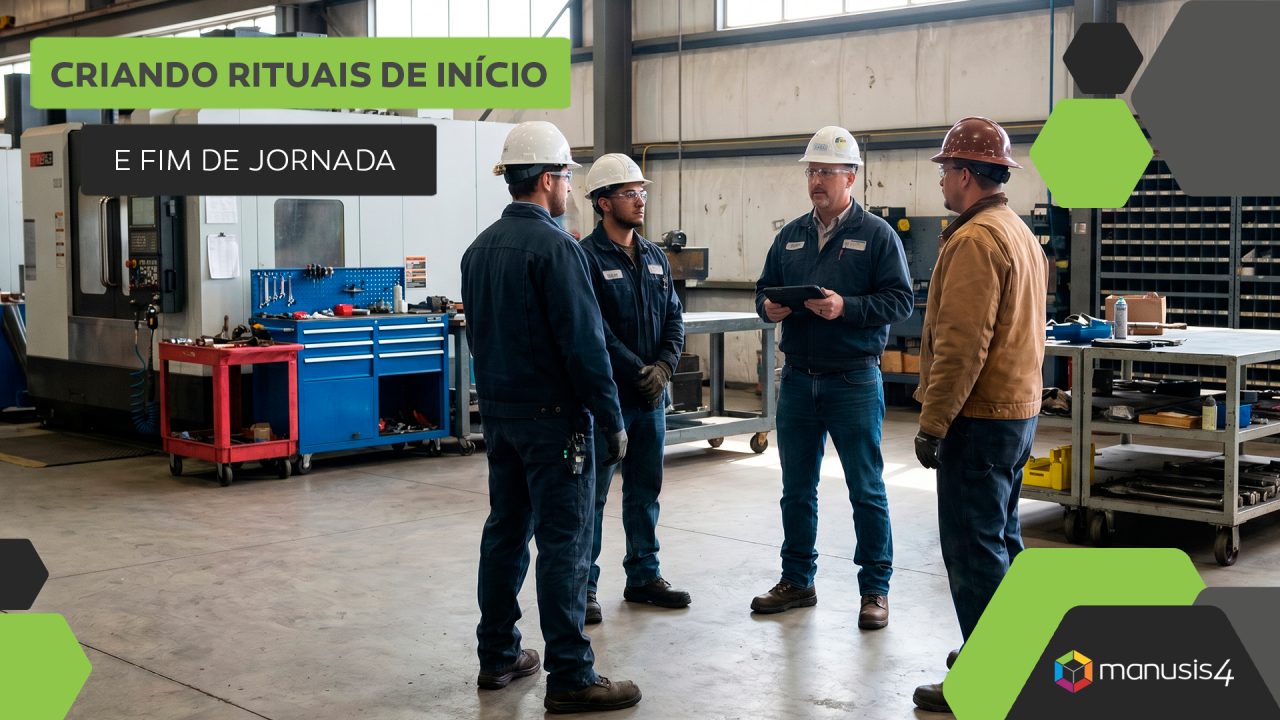
The two most underrated minutes of your team's day
Have you ever noticed how a team starts its shift?
Everyone arrives on their own clock.
One comes straight from traffic.
Another just had an argument at home.
Another slept three hours.
Another is excited about something personal.
Another isn't quite sure why they're even there.
And within a few minutes, all of them start opening work orders.
All of them start making decisions.
All of them start interacting with coworkers, managers and assets.
👉 Each one in a different mental state.
👉 Each one with a different emotional load.
👉 Each one working however they can, not however they'd like.
And at the end of the shift, it's the same thing in reverse.
Everyone leaves in their own way.
Carrying what happened, with nowhere to put it down.
Taking home what should have stayed at work.
Bringing to work what should have stayed at home.
And nobody talks about it.
Because "we're adults here, everyone deals with it."
But the truth is different:
👉 Technical teams don't just deal with it. Technical teams wear down.
And the wear starts precisely with the lack of a boundary between states.
What maintenance forgot about rituals
Almost every human culture, since forever, has created rituals to mark transitions.
Waking up. Eating. Working. Ending the day. Sleeping.
It isn't mysticism. It isn't fluff.
It's a very old brain mechanism:
The brain needs external markers to reorganize its internal state.
When those markers don't exist, the brain goes into diffuse mode:
- The mind works without knowing it has started
- The body operates without warning
- The day blurs into the one before
- The end of the shift never ends
And the result is a very common feeling among people who work in maintenance:
👉 "I'm tired, but I don't know from what."
👉 "I worked all day, but I don't feel like I delivered anything."
👉 "It's today already? I was sure it was still yesterday."
That isn't an individual failure.
It's the consequence of operating without rituals, in a culture that stopped creating conscious transitions.
What NLP teaches about this
Neuro-Linguistic Programming works with a simple, powerful concept:
Emotional state defines performance. Performance doesn't change emotional state.
In other words:
If you start the shift in a bad state, you'll deliver badly.
No matter how competent you are.
If you end the shift without closing the loop, you take everything home.
No matter how professional you are.
And the answer isn't "try harder."
The answer is to create a conscious transition, a gateway that tells the brain:
👉 "Now you're here."
👉 "Now you're no longer here."
And that's what a ritual does.
It isn't decoration.
It's mental engineering.
The invisible cost of a team without rituals
When the team has no start and end rituals:
- The start of the shift is chaotic (mistakes come easier)
- The middle of the shift is diffuse (focus is harder)
- The end of the shift is abrupt (rest is rarer)
- Personal life invades work, and vice versa
- The feeling of "work that never ends" sets in
- Weekends become an extension of the fatigue
And the most serious symptom:
👉 The team loses the ability to feel present, anywhere.
At work, thinking about home.
At home, thinking about work.
And the wear grows in silence.
Where does Manusis4 come in as an ally of rituals?
Here, Manusis4 does something much deeper than it seems:
It provides an objective anchor point for the start and end of the day.
How?
- The leader opens the system and sees: what's open, what's a priority, what can wait
- The team starts the shift with a clear queue, no guessing
- At the end of the day, everyone logs what they delivered
- The system shows, in real time, what's left for the next shift
- Decisions and incidents are documented, weighing on nobody's mind
That simple act, opening Manusis4 at the start and closing the loop at the end, works as the frame of the day.
And when you give the day a frame, you give the team back the ability to:
👉 come in with clarity
👉 leave with lightness
👉 be present in every moment
Technology applied well doesn't just speed up the operation.
It organizes the minds of the people who run it.
How to build simple rituals that work
An effective ritual has three characteristics:
- It's short (between 1 and 3 minutes)
- It's repeatable (the same every day)
- It has a physical gesture (because the body anchors the state)
Here are two practical examples, one for the start and one for the end of the shift:
Start ritual (90 seconds)
- Open Manusis4 and look at the day's queue
- In silence, take 3 deep breaths
- Tell yourself: "I'm here now, and I'm going to do my best"
- Set one intention for the shift (just one)
- Greet whoever has arrived, looking them in the eye
End ritual (90 seconds)
- Update in Manusis4 what was delivered
- Look at what's still open and breathe: it's not your problem right now
- Tell yourself: "I did what was possible with what I had"
- Say goodbye to the people leaving
- Leave the physical space marking it: "now my other life begins"
It isn't poetry. It's emotional engineering.
Those 3 minutes combined, 90 seconds at the start and 90 at the end,
change the whole rest of the day.
This week's reprogramming
"I don't walk into work. I start work. And I don't walk out of work. I close out work."
Repeat that sentence tomorrow morning.
Repeat it tomorrow night.
And notice the difference in how you feel, even before the week is over.
To wrap up
The difference between a worn-out team and a whole team
almost never lies in the workload.
It lies in the presence of transition rituals.
Teams that start the day consciously:
- make fewer mistakes
- communicate better
- deliver more
Teams that end the day with closure:
- truly rest
- sleep better
- come back more whole the next day
And it all starts with something simple:
👉 Two minutes. One at the start. One at the end. Every day.
Because, deep down, that's what emotional management is:
Honoring the invisible boundaries that hold up everything visible.