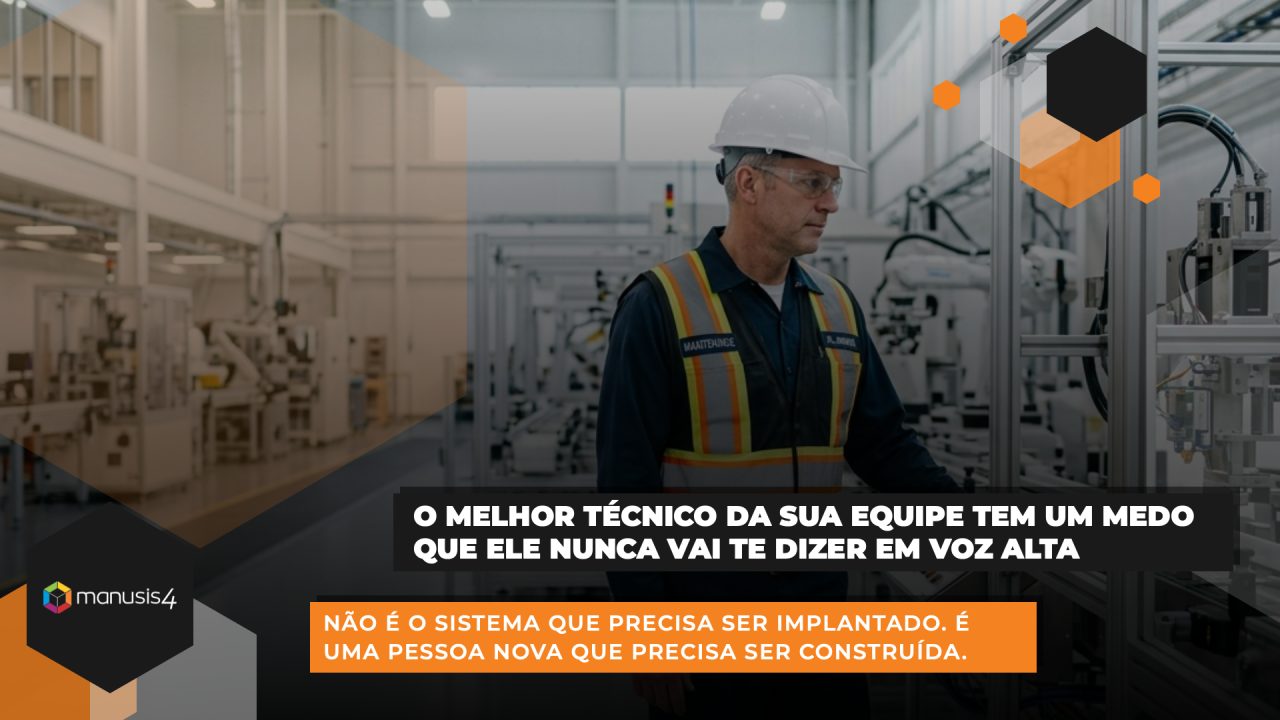
The best technician on your team has a fear he'll never say out loud.
It's not about technology.
It's that the machine will stop breaking.
Because on the day it stops breaking, he'll have to figure out who he is in this plant — and nobody has ever talked to him about that.
In the last five editions I talked about the digital mirror, too much data, the fear of being replaced, skeptical teams, and adoption as an emotional journey. Today I close this block where it really hurts: it's not the system that needs to be rolled out. It's a new person that needs to be built — and he's already here, sitting in your shop.
Brazilian maintenance was built on the rescue
Thirty years on the shop floor taught me something no KPI shows: we've trained entire generations of professionals whose greatest moment of recognition comes when something goes wrong.
Picture the scene. Line down. Production pushing. Leadership on the phone. And in walks the guy who's known that machine since 2009, puts his hand on it, listens to the noise, swaps the part, and the line comes back.
👉 In that minute, he's the most important professional in the plant.
Nobody applauds the preventive work done on Saturday that avoided that downtime. Nobody knows the name of whoever wrote the plan. The repair hero has an audience; the author of predictability doesn't.
Then Maintenance 4.0 arrives and says, with the best intentions in the world: let's eliminate unplanned downtime.
The unintended translation, heard by someone who built his whole career on the rescue: let's eliminate your stage.
Training doesn't fix it — because the problem isn't where you're aiming
There's a difference almost every leader ignores, and it explains why so much expensive training turns into no change at all.
When you want to change what someone does, training works. That's behavior. That's capability. You teach, practice, correct, repeat.
But when what's at stake is who the person believes they are in that place, training doesn't reach it. You can teach a technician to use the app in two hours. You won't teach someone, in two hours, to feel valuable for a different reason than the one that made them valuable for the last twenty years.
👉 Nobody defends the old way because they think the new one is worse. They defend it because the old way is where they know who they are.
And notice what happens when we confuse the two: leadership offers more courses for a problem that's about belonging. The technician takes the course, gets the certificate, and goes back to working exactly as before. It's not ill will. It's that his question was never answered.
His question is: if the machine doesn't break anymore, am I still needed here?
As long as that question goes unanswered, every digital transformation project will run into a wall that doesn't show up on any schedule.
Signs it's identity that's stuck, not the tool
You won't hear anyone say "I'm afraid of losing my place." You'll hear other things — and that's how you can read the problem:
- "I fix it faster my way." That's usually true. And that's exactly the problem: his way is fast and leaves no trace.
- The best technician is the one who logs the least in the system. He fixes it, the line comes back, and the knowledge stays in his head. Again.
- Generic work notes. "Repair work performed." Three words for a four-hour job. It's not laziness — it's someone protecting, maybe without realizing it, the one thing that makes him irreplaceable.
- The specialist becomes a bottleneck and likes it. If only he can fix that piece of equipment, he has a security no system offers.
- Silence in the KPI meeting. People who don't recognize themselves in that language don't discuss the number. They just wait for it to end.
👉 And there's the cost nobody puts on the spreadsheet: every experienced professional who leaves takes with him years of knowledge that never became a record. The next failure on the same equipment will cost much more to diagnose — and the bill doesn't show up anywhere, because it arrives diluted, months later, inside an MTTR nobody can explain why it went up.
What technology does here — and what it doesn't
I'll be honest about my own side of the table, because this series doesn't exist to sell software.
Manusis4 records, plans, schedules, measures, and keeps the history. The intelligence layer in Manusis4 was designed to suggest with its reasoning in plain sight — showing which history it relied on, what it considered, and what it doesn't know.
👉 Here's the point: a recommendation that shows its reasoning invites debate. A recommendation that just shows up on the screen invites obedience or revolt. There's no third option.
And here's what the software doesn't do, and it's important to say it:
It doesn't decide for anyone. It doesn't know that a specific gearbox runs hotter on third shift because the line runs heavier after 10 p.m. It doesn't know the noise your mechanic recognizes from thirty feet away.
That knowledge doesn't compete with the system. It's the input the system is missing.
A Digital Twin fed only by sensors is a model. Fed also by what the technician observed and recorded, it becomes the company's operational memory. The difference between the two isn't technological — it's how many people felt invited to contribute.
The new profile — and how to build it from the people you already have
It's not about hiring someone else. It's about bringing out capabilities your team already has that were never named as value. Five moves:
- Rename what he already does best. That technician isn't "the one who fixes things." He's the one who knows how to read the equipment. Diagnosis is the scarcest skill in Maintenance 4.0 — and it's his. Tell him that, in those words, before any system training.
- Turn logging into a technical act, not paperwork. Stop asking him to "fill out the work notes." Ask: "write down what you saw, the way you'd explain it to the guy who's going to take over this machine three years from now." It changes everything. One is a form; the other is leaving a legacy.
- Give him the role of correcting the machine that learns. When the AI gets a recommendation wrong, the person who corrects it should be the most experienced person on the team — and that should be visible. The specialist stops feeling threatened by technology on the day he becomes its teacher.
- Create a stage for predictability. If the only moment of recognition is the rescue, you're paying to keep a reactive culture. Start the meeting with the downtime that didn't happen. Say names. Every week.
- Teach him to talk outside the department. The professional Maintenance 4.0 demands has to explain asset risk to people who aren't in maintenance — production, purchasing, leadership. It's not generic communication skills. It's knowing how to translate "this bearing is going to fail" into "that's this many hours of line downtime and this much cost, and here's the window to avoid it."
👉 Notice that none of the five starts with software. Four are conversations. One is a calendar decision. That's what Maintenance 4.0 is made of — and that's why it takes longer than the schedule promises.
This week's reprogramming
Before you book the next training, answer this for yourself: am I asking this person to learn a tool, or to become someone else?
If it's the second — and it almost always is — then the conversation comes before the system. Always.
"Nobody resists technology. They resist becoming someone else without having chosen to."
Take this sentence to your next project meeting. It will explain delays your schedule can't.
Closing Block 9
Five editions ago I said the Digital Twin is a mirror of the way you think. We went through too much data, the fear of replacement, skepticism that has a history, adoption that's emotional before it's technical.
And we arrived here: the hardest asset to modernize in a plant isn't the machine. It's the idea each person has of their own value inside it.
👉 The technician who knows the machine best isn't an obstacle to Maintenance 4.0. He's its raw material. The only question is whether someone will talk to him before installing the system — or six months later, when adoption has stalled and the consultant has left.
Next week we open Block 10 — Software Onboarding and Adoption. We'll get into the first days of a project: what you do in the first weeks determines whether the platform becomes a work tool or just another system people fill out because the boss said so.
Until then.