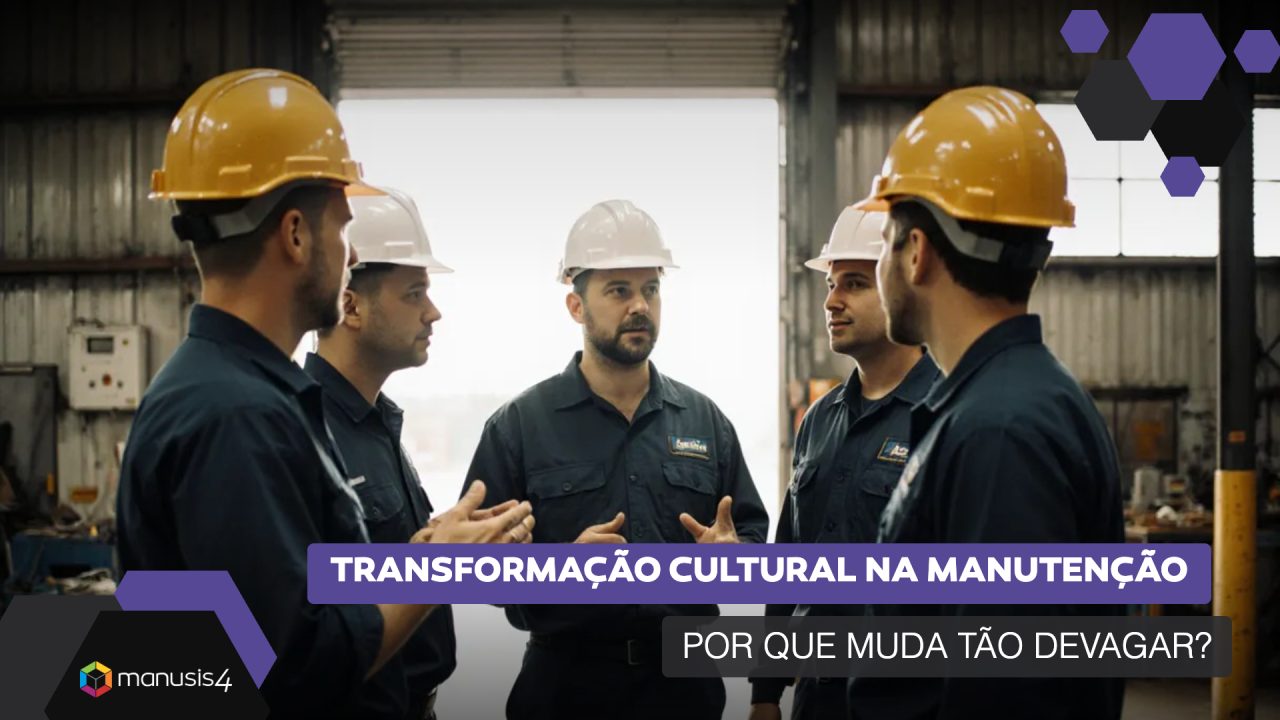
You changed the software. You changed the process. You changed the org chart. And the culture stayed the same.
Welcome to Phase 2 of our journey.
If you followed the 52 editions of Phase 1, you know we spent an entire year looking inward:
- At the mind of the maintenance professional.
- At the emotions that run through the technical day-to-day.
- At the quiet habits that support — or sabotage — the operation.
- At the identity that gets built (or worn down) over the years.
Now it's time to turn the key.
Because individual growth, on its own, has a ceiling.
And that ceiling has a name:
👉 Culture.
And starting today, we're stepping into the hardest — and most strategic — conversation a maintenance manager can have:
Why does my department's culture change so slowly?
If you've been a manager for a few years, you've probably hit your head against this wall.
You rolled out the system.
You trained the team.
You held the kickoff.
You presented the new process.
You approved the investment.
And months later, the culture was still the same.
The same conversations.
The same bad habits.
The same made-up emergencies.
The same improvising.
And then came the quiet, discouraging question:
👉 "Is this crew ever going to change?"
The answer is yes.
But to get there, you need to understand why culture resists — before you try to transform it.
The truth almost nobody tells you about culture
A lot of people treat culture as if it were organizational decor.
- A slogan on the wall.
- A value on a slide.
- A yearly training.
- A mid-year "culture" meeting.
But culture, for real, is none of that.
Culture is:
👉 What happens when the manager isn't looking.
It's the offhand comment in the locker room.
It's the joke passed around among technicians.
It's the silence when someone suggests something new.
It's the shrug when the system asks for a new routine.
It's "we've always done it this way," repeated under the breath.
It's the gut decision to do it the old way, even with the new process approved.
Culture is invisible collective habits.
And collective habits are stronger than any training — because they were built over years, often decades, in a specific environment.
Changing a training is easy.
Changing a collective habit… takes time, consistency, and presence.
What NLP teaches about cultural transformation
Neuro-Linguistic Programming has a powerful principle about groups:
Groups have a collective unconscious — and it runs with more force than any individual decision.
Every team carries:
- Shared emotional memories ("that time leadership changed everything and nothing worked")
- Invisible collective beliefs ("around here, whoever stands out ends up overloaded")
- Silent rituals ("at coffee break, nobody talks about problems")
- Implicit role models ("look at [veteran technician's name], that's how it's done")
And that collective unconscious has one fundamental trait:
👉 It doesn't change by decree.
It changes through conscious repetition of new patterns — over months, sometimes years.
That's why, when a manager rolls out a new tool or a new process and expects results in 30 days…
He's asking the culture for something it biologically can't deliver in that time frame.
It's not the team's ill will.
It's collective human nature.
The four silent saboteurs of cultural change
When you try to speed up change without understanding these principles, four saboteurs show up:
- Lack of consistency. You start with energy — and after 3 months you're back on autopilot. The culture feels it and pulls back with you.
- Too much talk, too little example. There's a lot of talk about the new culture, but the manager doesn't live it day to day. The team notices — and ignores the talk.
- Pressure without care. People are pushed for results from the new culture, but nobody takes care of those going through the change. That creates resistance.
- Ignoring the "guardians of the old way." Every team has people emotionally invested in the old culture — not out of malice, but out of identity. Ignoring them hands the process over to passive sabotage.
The combined effect of these four saboteurs is always the same:
👉 The official culture that's announced lives side by side with the real culture that's practiced.
And the real one always wins.
Where Manusis4 comes in as an ally of cultural transformation
This is where Manusis4 does something few people notice:
It creates objective evidence of the new behavior.
And evidence is the only real antidote to "we've always done it this way."
How?
- Every work order recorded in the new standard is a stone on the road away from the old culture.
- Every indicator that goes up shows the new way works.
- Every dashboard reviewed sparks a new conversation between technicians and managers.
- Every predictive analysis from Manusis4's AI reprograms the team's view toward the future.
- Every Digital Twin built shows the technology delivers real value — it's not "just another fad."
And most importantly:
👉 This happens every day. Quietly. Over months.
Technology, applied well, works as cultural infrastructure.
It doesn't replace conscious leadership — but it provides the solid ground where the new culture can be built.
And, over time, the culture changes.
But it changes at its own pace — not yours.
The strategic turning point
If you really want to transform your department's culture, start with an emotional decision:
👉 Stop fighting with time.
Culture doesn't change in a quarter.
Culture changes in multi-year cycles.
But it does change — when the manager:
- Keeps the same direction for years (not months)
- Lives the example before demanding it
- Publicly recognizes every small sign of the new culture
- Takes emotional care of the guardians of the old way — without shutting them out
- Lets the technology record, measure, and make the new standard visible
Doing this for 1 year creates visible change.
Doing this for 3 years creates structural change.
Doing this for 5 years creates a truly new culture.
And that's where the difference between an ordinary manager and a cultural transformer shows up.
This week's reprogramming
"Culture doesn't change because I want it to. It changes because I insist — with consistency, example, and care — for long enough."
Repeat this sentence before you feel frustrated with the slow pace of change.
Before you give up on a transformation project.
Before the next meeting where "we've always done it this way" shows up.
And watch your strategic patience grow.
To wrap up this opening of Phase 2
The cultural transformation of maintenance is the great silent challenge of our time.
While Industry 4.0 moves forward, while IoT becomes widespread, while Digital Twins become common, while AI enters the routine…
Culture has to keep up.
And it doesn't keep up through revolution.
It keeps up through conscious, sustained, patient evolution.
In this Phase 2, we'll dive into every layer of this transformation:
- How to measure your team's emotional maturity
- How to turn the department from a "cost" into a "strategic asset"
- How to reprogram the team's view toward the future
- How to lead different generations working together
- How to prevent burnout and take care of the team's mental health
- How to connect purpose, legacy, and technology
- And how Manusis4 supports this journey — from agriculture to the public sector, from healthcare to Industry 4.0
52 weeks.
New angles.
Same essence.
Because, deep down:
Emotional management doesn't end in Phase 1.
It becomes a system. It becomes culture. It becomes legacy.
And that's what we'll build together from here on.
See you next week.