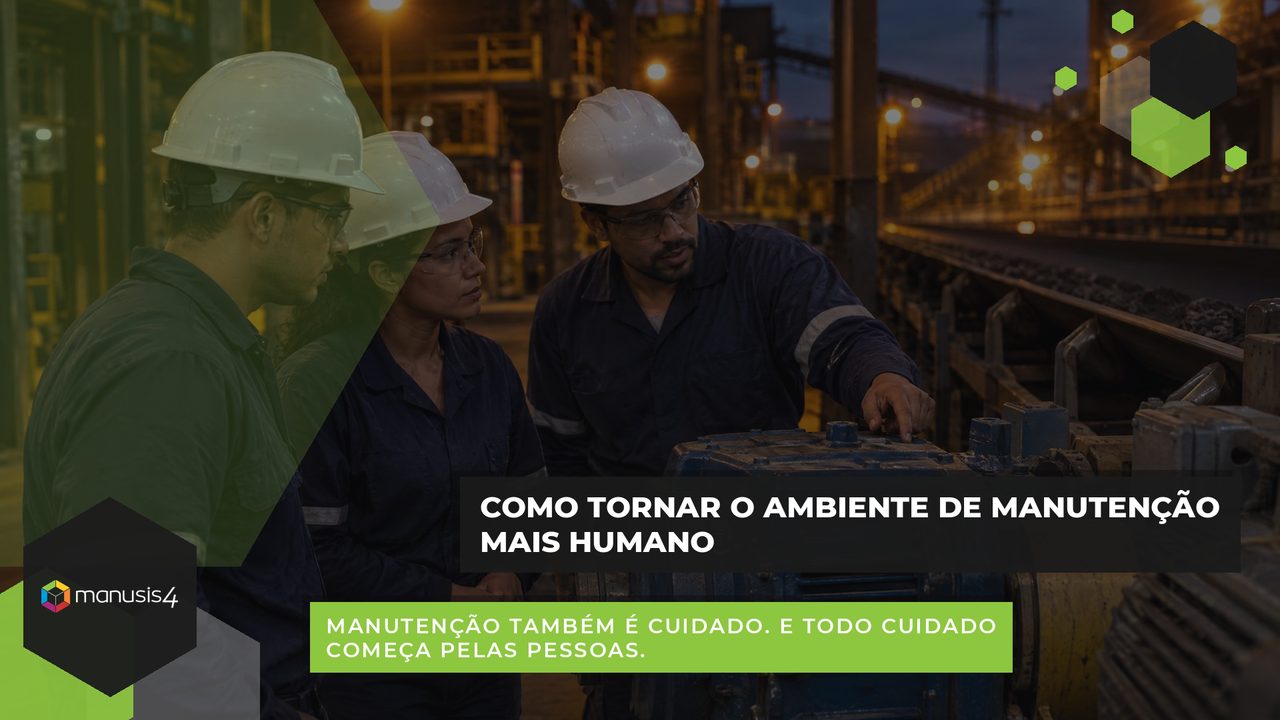
What changes a department's climate isn't the speech. It's the small, invisible gestures.
Have you ever walked into a maintenance shop and sensed, within seconds, that something was different there?
Not in the equipment.
Not in the org chart.
Not in the software.
But in something in the air.
The way people greeted each other.
The tone of voice in technical conversations.
The pace of the people walking by.
The presence (or absence) of laughter.
The way the leader approached the technician.
All of that makes up a silent field, and that field has a name:
👉 Emotional environment.
And that's where the difference lies between a team that delivers and a team that gives up.
The good news?
Humanizing that environment doesn't require a structural overhaul.
It doesn't require a billion-dollar project.
It doesn't require the executive team to get involved.
It requires something much simpler:
👉 Small gestures, repeated with intention.
Why has maintenance historically dehumanized its own environment?
Think about the field's cultural legacy.
Maintenance was born as a response to problems.
And whoever is born responding grows up reacting.
The rush, the urgency, the "we needed it yesterday" shaped a culture where:
- Talking is a waste of time
- Smiling is a lack of seriousness
- Caring for the caregivers is a luxury
- Dry technical language is a sign of competence
- Human warmth is HR's business, not the shop floor's
And so the environment took shape that way, naturally:
- Walls of demands, not of recognition
- Bulletin boards full of "warning," "danger," "mandatory"
- Technical rooms with no color, no light, no identity
- Conversations reduced to work orders, deadlines and priorities
- Communication by shouting when the stress kicks in
It isn't malice.
It's legacy.
And like any legacy, it can be revisited, when someone decides to look at it with fresh eyes.
What NLP teaches about environment and state
Neuro-Linguistic Programming works with a key concept:
The external environment shapes the internal state, and the internal state defines behavior.
In practical terms:
- A gray, cold, purely technical environment → produces gray, cold, robotic minds
- A warm, welcoming, clear environment → produces present, creative, cooperative minds
That isn't fluff.
It's neuroscience applied to operations.
And when the leader understands that, they stop treating the environment as a backdrop…
and start treating it as an emotional management tool.
Because every element of the space speaks to the team's unconscious, all the time.
The color of the walls speaks.
The sentence on the board speaks.
The lighting speaks.
The tone of the last conversation still echoing speaks.
And that "silent speech" influences everything: focus, decisions, relationships, performance.
The symptoms of an emotionally dehumanized environment
When a department has been running in "technical only" mode for a long time:
- The team comes in quiet and leaves tired
- Nobody celebrates deliveries; they just put out fires
- The technician doesn't know the name of the coworker on the next shift
- The leader only talks to their direct reports when there's a problem
- The physical space feels like it never belonged to anyone
- The walls don't tell any story
- The hallways don't invite a pause
And the most serious symptom:
👉 People start to feel interchangeable.
As if they were parts in a machine, not human beings contributing to a purpose.
And that feeling, repeated every day, slowly kills belonging.
Where does Manusis4 come in as an ally of humanization?
Here comes a powerful layer that few people notice.
Manusis4 humanizes the environment in a very specific way:
It gives the people inside the operation a name, a voice and visibility.
How?
- Every work order carried out has an owner recognized by the system
- The technician's history is recorded; it doesn't vanish when they go on vacation
- Contributions show up on dashboards (not in the manager's monologues)
- The system lets you see WHO solved it, WHEN, HOW and WHY
- Technical information stops belonging to "someone" and becomes "so-and-so's"
That simple act, putting a name on each person's work, transforms the environment.
Because humanizing isn't putting a plant in the office.
Humanizing is making people see themselves, be seen and recognize themselves there.
And when technology does that well, it becomes a vehicle for belonging, not for control.
How to humanize the environment without any formal project
You don't need a budget.
You don't need executive approval.
You don't need consultants.
You just need to start with small, consistent gestures. Here are seven that cost almost nothing, and change everything:
- Greet people by name. Not "hey, tech." It's "good morning, Rodrigo."
- Ask how the person is doing before asking how the work order is doing.
- Put a human sentence on the bulletin board, not just targets.
- Publicly recognize small deliveries, not just the big ones.
- Create a physical space for pausing: a chair, a table, a coffee that makes sense.
- Replace "I need you to do" with "I'm counting on you for this."
- End meetings with a human question, not with one more task.
Seven gestures. Seven days. Seven seeds.
In a week, the environment already feels it.
In a month, the team already notices.
In three months, the culture starts to turn.
This week's reprogramming
"I don't just lead tasks. I lead people, in an environment I create myself, every day, through the way I speak, look and show up."
Repeat that sentence before your next meeting.
Before your next shift handover.
Before your next critical work order.
And notice how the way you arrive changes the way the environment responds.
To wrap up
Humanizing the maintenance environment doesn't mean abandoning technique.
It means giving technique back its original purpose: taking care of something, and someone, that matters.
Teams in human environments:
- make fewer mistakes
- learn faster
- quit far less often
- attract talent naturally
- deliver better numbers, without even noticing
And it all starts with a choice:
👉 Stop treating the team as a means. Start treating it as an end.
It isn't a grand choice.
It's an everyday choice.
But it's precisely in everyday choices that culture is born, or dies.
Because, deep down:
Maintenance is also care.
And all care starts with people.